
What Is Sheet Metal Fabrication? When It Makes Sense and Why the Process Matters
Why the Sheet Metal Fabrication Process Matters More Than You Think
When evaluating a part, it is easy to focus on the final design. Dimensions, tolerances, materials, and cost tend to drive most decisions, especially in the early stages of product development. However, what is often overlooked is how much the manufacturing process itself influences the final outcome.
In many cases, the real difference in performance, cost efficiency, and long-term reliability comes from how that part is produced. Factors such as process control, material handling, equipment precision, and production flow all play a critical role in determining whether a part performs consistently in full production.
For manufacturers across the United States, particularly in industries such as electronics, infrastructure, and industrial equipment, sheet metal fabrication has proven to be one of the most reliable and scalable production methods. When supported by strong quality systems and efficient production environments, it allows teams to maintain tighter control over timelines, reduce variability, and improve overall product performance.
Understanding when and why to use sheet metal fabrication, and just as importantly, how the process is managed, can make a measurable difference in how efficiently a product moves from concept to production and how well it performs over time.
What Is Sheet Metal Fabrication?
Sheet metal fabrication is a manufacturing process for creating parts and components from flat metal sheets. These sheets are cut, formed, and assembled into finished products using a combination of precision equipment and skilled labor.
Common processes include:
-
Laser cutting for precise shapes and tight tolerances
-
Punching for repeatable features and high-volume efficiency
-
Press braking for forming bends and structural geometry
-
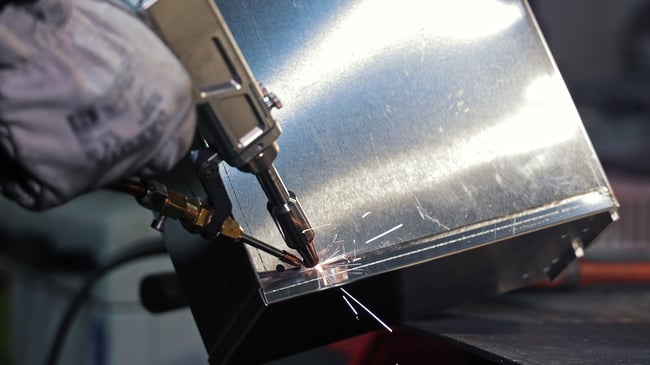
Welding (TIG and MIG) for assembly and strength
-
Finishing processes, such as powder coating, for durability and protection
The result is a highly versatile process capable of supporting everything from simple brackets to complex enclosures and assemblies.
When Does Sheet Metal Fabrication Make Sense?
Sheet metal is not the right choice for every application, but it excels in scenarios where performance, consistency, and long-term reliability are critical. Compared to alternative materials and processes, it offers a balance of strength, precision, and scalability that is difficult to match when projects move beyond simple or low-demand use cases.
It becomes especially valuable when production requirements extend beyond basic functionality and begin to demand durability, repeatability, and tighter control over how parts are made and delivered.
It is often the best fit when:
-
Strength and durability are critical: Metal components can withstand impact, vibration, and harsh environments better than many alternative materials.
-
Precision and repeatability are required: Modern fabrication processes enable tight tolerances across both small and large production runs.
-
Your design includes formed features: Bends, cutouts, and structural geometry can be integrated directly into the part without secondary processes.
-
You need scalability: Sheet metal supports both prototyping and high-volume production without requiring significant design changes.
-
Long-term value matters more than upfront cost: While initial costs may vary, durability and lifecycle performance often make sheet metal more cost-effective over time.
The Importance of Sheet Metal Integration
In sheet metal fabrication, as mentioned above, the process itself plays just as important a role as the final design. How parts move from raw material to finished product directly impacts lead times, quality, and overall production efficiency.
For manufacturers operating in North America, particularly those supporting U.S.-based programs, proximity and integration have become increasingly important. Working with a nearshore partner in Mexico, such as our facility based in Tijuana, allows companies to reduce transit times, improve communication, and maintain closer oversight of production without sacrificing cost efficiency.
When fabrication, finishing, and assembly are handled across multiple vendors, projects often face delays between stages, limited visibility, and a higher risk of misalignment. In contrast, integrated operations that bring these capabilities together under one roof, such as those offered by SWARCO McCain, create a more controlled and predictable manufacturing environment.
A General Breakdown of the Sheet Metal Fabrication Process
While every project has its own requirements, most sheet metal fabrication programs follow a structured process designed to ensure efficiency, accuracy, and consistency from start to finish.
-
Design Review and Engineering Support
The process begins with a detailed review of the part design to ensure it is optimized for manufacturability. This step helps identify potential challenges early, such as complex geometries, material limitations, or tolerance issues, and enables adjustments that can reduce costs and improve production efficiency.
-
Material Selection
Choosing the right material is critical to performance. Factors such as strength, weight, corrosion resistance, and environmental exposure all play a role in determining whether aluminum, stainless steel, or cold-rolled steel is the best fit for the application.
-
Cutting and Forming
Once the design and materials are finalized, the part moves into production. Laser cutting and punching create precise shapes and features, while press braking forms bends and structural geometry. These steps define the component's core shape and functionality.
-
Assembly and Welding
For more complex parts or assemblies, welding processes such as TIG and MIG are used to join components and ensure structural integrity. This stage is critical for applications that require strength and durability under load or in demanding environments.
-
Finishing
Finishing processes, including powder coating, are applied to enhance durability, corrosion resistance, and appearance. This step also ensures the part meets any environmental or performance requirements specific to its end use.
-
Inspection and Quality Control
Before parts are released, they undergo inspection to verify that all specifications and tolerances are met. Strong quality systems ensure consistency across production runs and reduce the risk of defects or rework.
Are You Ready for Custom Sheet Metal Fabrication Services?
Sheet metal fabrication remains one of the most reliable and adaptable manufacturing processes available today. For teams evaluating materials and production methods, the decision often comes down to more than just cost. It is about finding a process that delivers strength, consistency, and scalability without introducing unnecessary complexity into the supply chain.
In today’s manufacturing environment, factors such as lead-time reliability, supply chain visibility, and proximity to production are playing a greater role in decision-making. Many companies are re-evaluating how and where their parts are produced, with a growing focus on nearshore manufacturing solutions that can support both efficiency and control.
If you are ready to move forward with custom sheet metal fabrication, working with the right partner makes all the difference. At SWARCO McCain, we bring laser cutting, punching, CNC press braking, welding, and in-house finishing together under one roof, allowing projects to move seamlessly from raw material to finished product. With ISO-certified quality systems, a nearshore facility in Tijuana, Mexico, and U.S.-based engineering and account support, we help you reduce complexity, improve communication, and maintain control at every stage of production. The result is a more predictable, efficient manufacturing process built to support both your current needs and future growth.
Frequently Asked Questions
Is sheet metal better than plastic for enclosures?
It depends on the application. Sheet metal offers greater strength, heat resistance, and durability, while plastic may be better for lightweight or cost-sensitive designs.
Can sheet metal support both prototypes and production runs?
Yes. Sheet metal fabrication is well-suited for both early-stage prototypes and scaled production.
How precise is sheet metal fabrication?
Modern equipment enables tight tolerances and high repeatability, especially when supported by robust quality systems.
What industries commonly use sheet metal fabrication?
Industries such as electronics, telecommunications, transportation, infrastructure, and industrial manufacturing rely heavily on sheet metal components.