SWARCO McCain Enhances Traffic Performance on Duff Avenue in Ames Iowa with MyCity Adaptive Control
Ames, IA
Overview
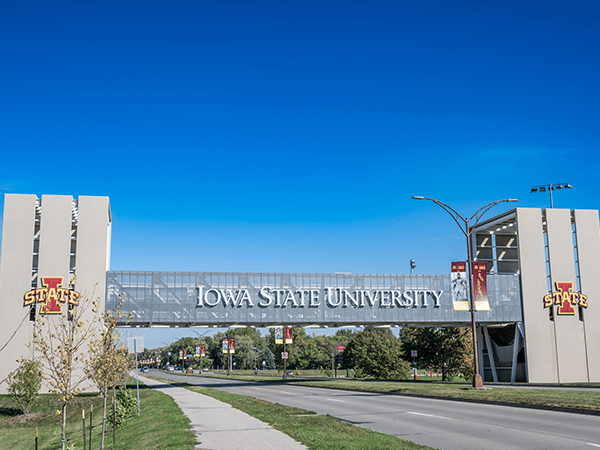
Since March 2025, key streets surrounding the stadium in Ames, Iowa, have leveraged MyCity Adaptive to optimize traffic flow in real-time to manage gameday surges across 14 intersections.
Location
Ames is a city in central Iowa with about 66,000 residents spanning approximately 28 square miles. Located about 30 miles north of Des Moines, it is home to Iowa State University and is the ninth-largest city in the state.
The Challenge
Traffic on the Duff Avenue corridor from Crystal Street to 13th Street varies throughout the day, with strong peak periods and major increases on football game days. In traditional Free operation, each intersection functions independently, relying on detector inputs and preset minimum and maximum green times to determine phase changes. This can limit coordination, contribute to congestion, and require multiple cycles to clear queued vehicles during periods of high demand. Both daily peaks and event-related surges made a more adaptive solution essential.
Solution
SWARCO MyCity Adaptive was deployed to dynamically adjust green times, cycle lengths, and offsets in response to detected vehicle demand. The system eliminates the need for time-of-day coordination plans and instead continuously optimizes signal progression along the corridor. A dedicated gameday plan was added to accommodate the heavy traffic entering and leaving football events, while the system automatically suspends operations during very low-volume conditions, such as snow days.
The Results
Comparing travel times between a day using MyCity Adaptive and a day using Free operation showed clear benefits. Although traffic volumes were slightly higher on the Free operation day, MyCity Adaptive improved travel times in both directions during the morning and evening peaks. The most notable improvement occurred during the evening southbound rush, where travel times were 29 percent shorter and drivers were more likely to pass through the corridor
without stopping. Under Free operation, heavy evening traffic sometimes required drivers to wait through two full signal cycles at a single intersection, a delay that was not observed when using MyCity Adaptive.
Benefits of MyCity Adaptive
- Improve arterial performance
- Adjust to real-time traffic demand
- Reduce stops, delays, and travel time
- Boost intersection efficiency and mobility
- Analyze arterial performance with high-resolution data reports